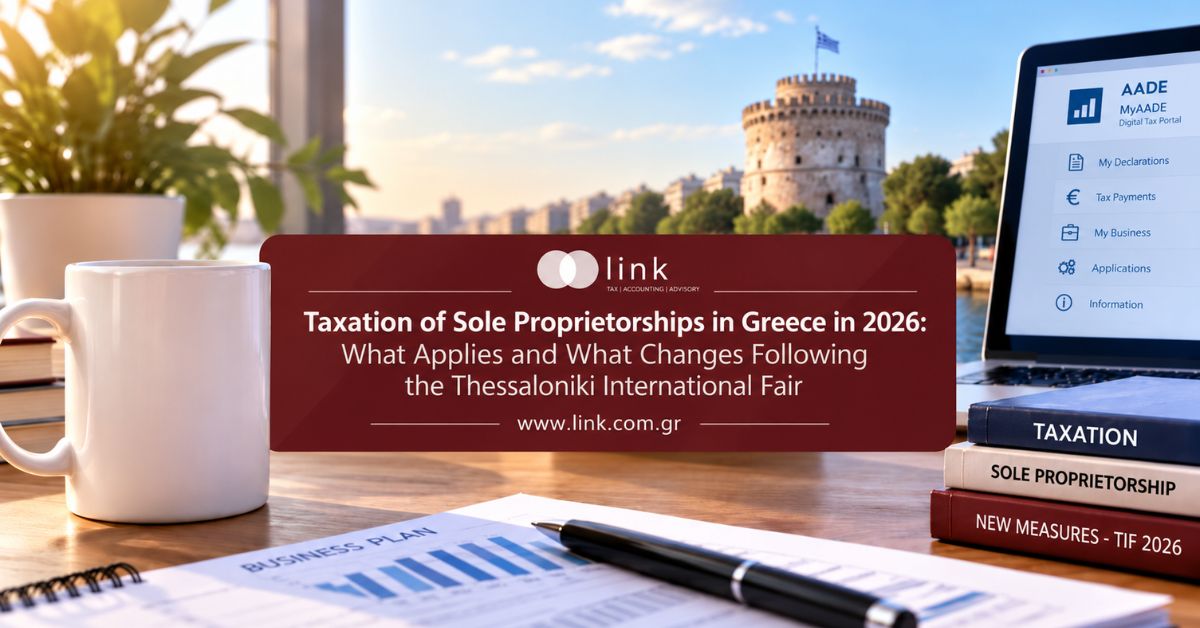
Sole proprietorship taxation in Greece is an important consideration for every self-employed professional and individual business owner. Whether you are planning to start a business or already operate as a sole proprietor, understanding how business profits are taxed, how the minimum presumptive income is calculated and which tax changes apply in 2026 is essential for effective financial planning.
Sole proprietorship taxation in Greece in 2026 includes significant changes to the income tax scale, while additional measures affecting the presumptive taxation system for self-employed professionals were announced at the 90th Thessaloniki International Fair (TIF) in September 2026.
Income Tax Rates for 2026
From the 2026 tax year onwards, a revised income tax scale applies to income from business activity.
| Taxable Income | No Children | 1 Child | 2 Children | 3 Children | 4 Children |
|---|---|---|---|---|---|
| €0 – €10,000 | 9% | 9% | 9% | 9% | 0% |
| €10,000.01 – €20,000 | 20% | 18% | 16% | 9% | 0% |
| €20,000.01 – €30,000 | 26% | 24% | 22% | 20% | 18% |
| €30,000.01 – €40,000 | 34% | 34% | 34% | 34% | 34% |
| €40,000.01 – €60,000 | 39% | 39% | 39% | 39% | 39% |
| Over €60,000 | 44% | 44% | 44% | 44% | 44% |
For taxpayers with more than four dependent children, an additional reduction is provided for the tax rate applicable to the €20,000–€30,000 income bracket.
More favourable tax treatment also applies to younger taxpayers from the 2026 tax year onwards.
For taxpayers aged up to 25, the tax rates applicable to the first two income brackets, covering income of up to €20,000, are reduced to zero.
For taxpayers aged 26 to 30, the tax rate applicable to the portion of income between €10,000 and €20,000 is reduced to 9%.
Sole Proprietorship Taxation in Greece: How Is Tax Calculated?
Profits from business activity are taxed from the first euro in accordance with the applicable income tax scale, including any reduced rates available depending on the taxpayer’s age and number of dependent children.
At the same time, individuals carrying out business activities may also be subject to the minimum presumptive income regime where their declared taxable income is lower than the amount determined under the relevant tax provisions.
This system should not be confused with the general rules on deemed living expenses relating, for example, to residential property or vehicles. It specifically concerns the determination of a minimum taxable income arising from individual business activity.
Tax Incentive for Newly Established Sole Proprietorships
Individuals within the first three years of carrying out business activity may benefit from a 50% reduction in the tax rate applicable to the first income bracket, provided that their annual gross business income does not exceed €10,000.
At the same time, the minimum presumptive income rules do not apply during the first three years following the commencement of the taxpayer’s first business activity.
Income Tax Prepayment
Sole proprietorships and self-employed professionals are required to pay, in addition to their income tax liability, an advance payment of income tax against the following tax year.
For the 2026 tax year, the advance tax payment remains at 55% of the income tax arising from business activity.
At the 2026 Thessaloniki International Fair, a further reduction of the advance income tax payment from 55% to 50% as of the 2027 tax year was announced.
If enacted as announced, the change will therefore be reflected in tax returns filed in 2028.
Presumptive Taxation of Sole Proprietorships: What Applies in 2026?
Income from individual business activity is currently subject to a system establishing a minimum presumptive net income, which may reach up to €50,000.
The basic component used in the calculation is linked to the annual amount of the statutory minimum wage and increases depending on the number of years the business has been operating.
Following the increase in the statutory minimum wage to €920 as of 1 April 2026, the corresponding annual reference amount used in official examples for the 2026 tax year stands at €12,880.
When Does the Minimum Presumptive Income Apply?
The minimum presumptive income does not apply during the first three years following the initial commencement of business activity.
During the fourth year, the relevant amount is reduced by two thirds.
During the fifth year, it is reduced by one third.
From the sixth year onwards, the full base amount applies, together with any additional adjustments provided for under the tax legislation.
How Is the Minimum Presumptive Income Currently Calculated?
Under the current system, the minimum taxable income is determined on the basis of three main factors:
- The amount calculated on the basis of the statutory minimum wage and the number of years the business has been operating;
- An additional amount equal to 10% of the annual payroll cost of employees, subject to the statutory limits;
- An additional amount equal to 5% of the difference between the business’s annual turnover and the average annual turnover of businesses operating under the relevant Greek Activity Code (KAD), where applicable.
Specific provisions also apply where the annual gross remuneration of the highest-paid employee exceeds the amount calculated under the general minimum-income formula.
What Changes Following the 2026 Thessaloniki International Fair Announcements?
The most significant measure announced at the Thessaloniki International Fair concerns the two additional components currently used to increase the minimum presumptive income.
For tax-compliant self-employed professionals, it has been announced that, from the 2026 tax year onwards, the following adjustments will no longer apply:
1. The 10% increase based on annual payroll costs.
2. The 5% increase calculated on the difference between the business’s turnover and the average turnover of businesses operating under the corresponding activity code.
This is an important development.
However, the core presumptive income system linked to the statutory minimum wage and the number of years of business activity is not being abolished.
Instead, the proposed changes remove the additional presumptive burden arising from payroll and turnover for professionals who meet the required tax-compliance criteria.
According to the Government’s official presentation of the measures, approximately 156,000 sole proprietorships are currently affected by these two additional adjustments.
Who Will Be Considered a “Tax-Compliant” Self-Employed Professional?
According to the measures announced and further specified by the Ministry of National Economy and Finance, professionals will need to meet a number of conditions in order to qualify for the exemption from the two additional presumptive-income adjustments.
In particular, taxpayers are expected to be required to:
- Have transmitted all required information to myDATA for the relevant tax year;
- Where legally required, have completed the interconnection of their POS terminal and cash register and maintain the connection throughout the tax year;
- Have received no penalties from the tax administration or the Labour Inspectorate during the previous five tax years;
- Have submitted all required VAT and income tax returns for the previous five tax years.
If the measure is enacted on this basis, tax compliance, timely electronic reporting and proper bookkeeping will become even more important in determining the final tax liability of a sole proprietorship.
Example: How Much Could the Tax Liability Be Reduced?
The Ministry of National Economy and Finance has presented an example involving a sole proprietorship in the food service sector that has been operating for 15 years, employs five people and has annual payroll costs of €105,000.
Under the current system, the basic presumptive income of €16,744 is increased by €10,500 due to payroll costs, bringing the minimum taxable income to €27,244.
The resulting income tax amounts to €4,783.
Under the proposed new regime, provided that the business qualifies for the exemption from the payroll adjustment, the minimum taxable income would remain at €16,744 and the resulting tax would fall to €2,249.
This represents an annual tax reduction of €2,534.
The change is particularly relevant for sole proprietorships operating in sectors such as food service and retail, where employing staff could previously result in a substantial increase in the taxpayer’s presumptive taxable income.
Reduction of Presumptive Income for Businesses in Small Settlements
The current framework already provides for a 50% reduction in the minimum presumptive income for certain taxpayers who both operate their business and maintain their main residence in small settlements, subject to population thresholds and other statutory conditions.
At the 2026 Thessaloniki International Fair, a further extension of this measure was announced.
The 50% reduction is expected to apply to settlements with populations of up to 2,000 residents, while in Western Macedonia the threshold is expected to increase to 2,200 residents.
Settlements located in the Region of Attica are excluded, with the exception of the Regional Unit of Islands.
What Changes for Taxi Operators?
Under the current framework, a 50% reduction in the minimum presumptive income applies to taxi operators holding an ownership interest of up to 25% in the vehicle.
Under the measures announced at TIF 2026, the calculation is expected to become proportional to the taxpayer’s actual ownership percentage.
For example, where a professional owns 50% of a taxi, the presumptive income would also be reduced by 50%.
An exemption from the presumptive-income regime has also been announced for minors under the age of 18 who hold a taxi licence, a situation generally arising through inheritance.
Reductions and Exemptions from the Minimum Presumptive Income
In addition to the newly announced measures, existing Greek tax legislation already provides for reductions or exemptions for specific categories of taxpayers.
Among others, the minimum presumptive income may be reduced by 50% for large families, individuals with a disability of at least 67%, certain single-parent families, parents of dependent children with disabilities, operators of school canteens and other categories specified by law.
Special reductions also apply to qualifying businesses operating in small settlements and on certain islands, subject to the requirements set out in the legislation.
Women operating a sole proprietorship are also exempt from the minimum presumptive income in the year in which they give birth, adopt or become foster parents, as well as during the following two years.
Can the Minimum Presumptive Income Be Challenged?
Yes.
The minimum presumptive income is a rebuttable presumption.
Where a taxpayer believes that their actual income was lower due to objective circumstances or other reasons recognised under the tax legislation, they may follow the prescribed procedure to challenge the amount determined under the presumptive-income rules.
In certain cases, this process may result in a tax audit and may require the taxpayer to provide detailed information regarding their financial and asset position.
What Else Was Announced at TIF for Self-Employed Professionals?
The changes to the presumptive-income system are not the only measures affecting self-employed professionals.
From the 2027 tax year, the advance income tax payment is expected to be reduced from 55% to 50%.
In addition, a zero tax rate for income up to €20,000 was announced for taxpayers with three dependent children, starting from the 2027 tax year.
This means that the measure would apply to tax returns filed in 2028 and should not be confused with the income tax scale already applicable for the 2026 tax year.
A zero income tax rate on income of up to €20,000 was also announced for professional farmers, starting from the 2026 tax year, subject to the requirements that will be set out in the final legislation.
What Do These Changes Mean for a Sole Proprietorship?
The measures announced at the Thessaloniki International Fair do not abolish Greece’s minimum presumptive income system.
They do, however, significantly change its impact for a large number of self-employed professionals.
Where the tax administration already has access to detailed electronic information through myDATA, POS terminals and interconnected cash-register systems, and where the taxpayer consistently meets their tax obligations, the proposed framework would remove the additional presumptive burden currently arising from higher turnover or payroll costs.
For sole proprietorships, this makes proper tax planning, timely electronic reporting and accurate financial management even more important.
Taxation should not be addressed only when the annual income tax return is due. Effective planning throughout the year allows a business to anticipate its tax liabilities, make use of available tax reliefs and make better-informed decisions regarding its development, cash flow and profitability.
With more than 35 years of experience in accounting, tax and business advisory services, Link Consulting supports entrepreneurs and businesses in understanding the tax changes that affect them and in planning their financial and tax strategy in a timely and effective manner.
Contact our team to discuss how the 2026 tax changes may affect your business and how you can prepare accordingly.
This article has been updated on the basis of the measures announced and officially presented following the 90th Thessaloniki International Fair. Where measures have not yet been enacted into law, the final applicable framework will be determined upon publication of the relevant legislative provisions.