
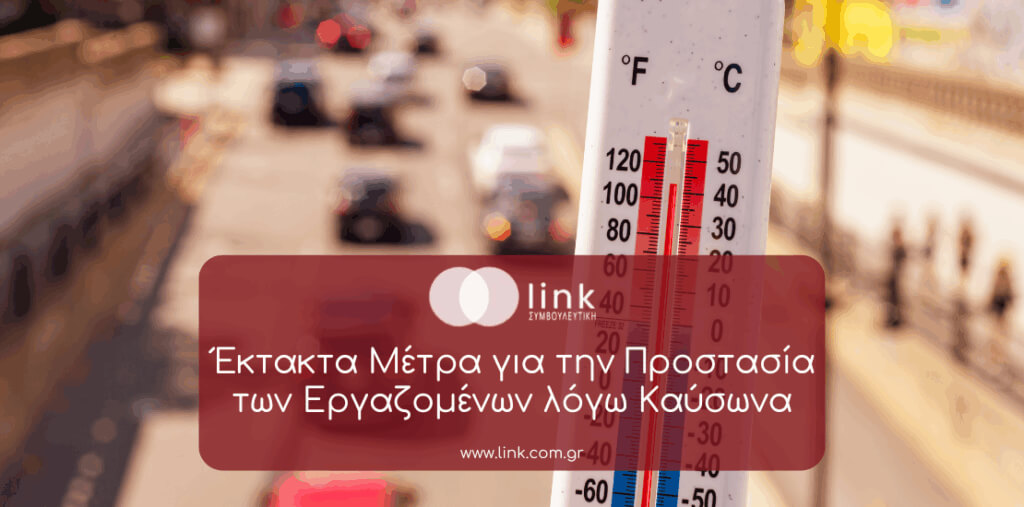
Due to the exceptionally high temperatures expected on Monday, July 7, 2025, the Ministry of Labor and Social Security announced the implementation of emergency measures to protect private sector employees from heat stress. These initiatives are deemed essential for the safety and health of workers, particularly in sectors operating outdoors or in non-air-conditioned environments. This article provides a detailed overview of the measures coming into effect, recommendations for employers and employees, and the competent authorities’ weather forecasts for the day.
Employee Protection Measures Against Heat Stress
A. Preventive Measures for Private Sector Employees
To protect employees with dependent employment relationships from high temperatures, employers are required to implement technical and organizational measures. These measures are outlined in circular no. 34666/June 3, 2024, titled “Prevention of Heat Stress for Employees” (ADA: ΡΓ1Ν46ΝΛΔΓ-ΩΟ6), and serve as an indicative, not exhaustive, guide for their application.
B. Mandatory Work Stoppage in Outdoor Areas
On Monday, July 7, 2025, due to the extreme temperatures forecast by the HNMS, a mandatory suspension of manual outdoor work is imposed from 12:00 PM to 5:00 PM in the following areas:
-Central Macedonia
-Ionian Islands
-Western Greece
-Thessaly
-Messenia
-Samos
-Eastern part of Rhodes
The suspension applies to activities such as civil engineering works, construction sites, ship repair zones, deliveries by two-wheeled vehicles (e.g., food delivery), etc. All employees are covered, irrespective of their employment relationship, including those working through digital platforms (Article 68 of Law 4808/2021).
Should the delivery suspension be enforced, it applies to all delivery businesses, whether they operate with a physical storefront or digitally. Only store pickup (takeaway) or order fulfillment using air-conditioned vehicles is permitted, excluding two-wheeled vehicles and mopeds.
Exceptions:
The mandatory suspension does not apply to critical infrastructure in the health, transport, and public utility sectors, such as hospitals, electricity, water supply, and transportation, provided that all prescribed protection measures are taken.
Penalties:
Non-compliance incurs an administrative fine of 2,000 euros per employee, according to Articles 23 and 24 of Law 3996/2011 (A’ 170).
C. Teleworking for Vulnerable Groups
Employees belonging to vulnerable groups (according to Annex 2 of circular 34666/June 3, 2024) and located in areas of high heat risk must, where feasible, work remotely to be protected from adverse conditions.
D. Emergency Flexibility in Working Hours
For better management of employee arrival and departure in affected areas, employers may temporarily modify working hours without the obligation to pre-declare changes to the ERGANI Information System.
Link Consulting S.A.
LINK Building – Ath. Kanellopoulou 13
“Nea Elvetia” Metro Station
Voulgari Area, PC 54248, Thessaloniki
2310 285861
admin@link.com.gr